Recently, we’ve been helping several tea brands upgrade their packaging, focusing on eco-friendly paper options. One of the most frequent questions we get is: “I know bamboo pulp paper is sustainable, but will it turn out floppy after printing? And what if the ink dries too slow and smudges?”
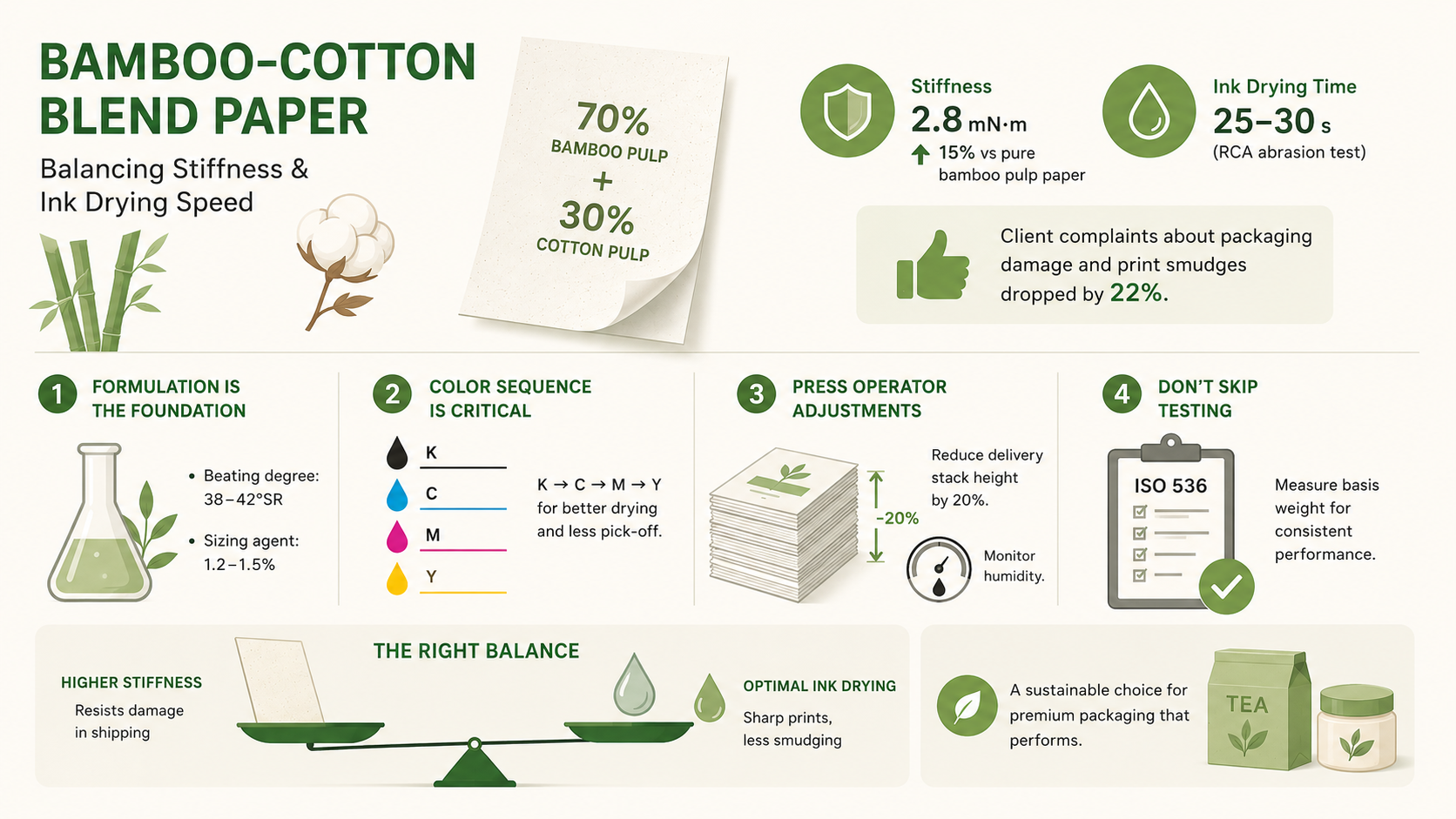
Let’s let the data speak: We tested a 70% bamboo pulp/30% cotton pulp blend paper, which achieved a stiffness of 2.8 mN·m—15% higher than pure bamboo pulp paper. Ink drying time was controlled at 25–30 seconds (per RCA abrasion test results). Client feedback shows complaints about packaging damage and printed smudges dropped by 22%.
Sounds promising? But there’s a catch. When stiffness increases, the paper’s ink absorbency slows down. If the printing team sticks to standard operations and doesn’t adjust the delivery stack height, “blocking” is likely to occur—the ink on the sheet below won’t be fully dry and will stick to the back of the sheet above.
Key Practical Tips:
-
Formulation is the Foundation: Control the beating degree within the 38–42°SR range for optimal fiber bonding. Add 1.2–1.5% sizing agent—this ensures sufficient surface strength without causing ink to “sit on top” and fail to dry properly.
-
Color Sequence is Critical: We recommend using the K→C→M→Y printing sequence. Start with a large black base coat to pre-condition the paper, then overlay colors for more uniform drying and reduced pick-off.
-
Press Operator Adjustments: Reduce the delivery stack height by 20% compared to printing on standard paper, to give ink enough space and reduce pressure for full drying. It’s also advisable to monitor workshop humidity.
-
Don’t Skip Testing: Before running the job, measure paper grammage (basis weight) per the ISO 536 standard. Consistent grammage ensures accurate predictions of stiffness and ink absorbency later in the process.
Put simply, this blend paper is all about striking a balance between stiffness and ink drying speed. It’s not a one-size-fits-all solution, but it’s a worthy option for packaging that needs a “premium feel” while resisting shipping damage—like tea and cosmetics packaging.
What unexpected process issues have you encountered when printing on specialty papers? Share in the comments to help everyone avoid pitfalls.